
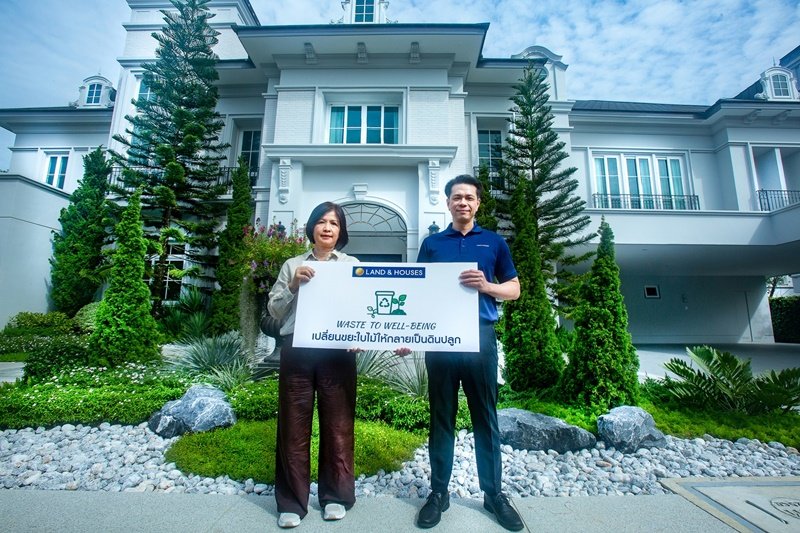
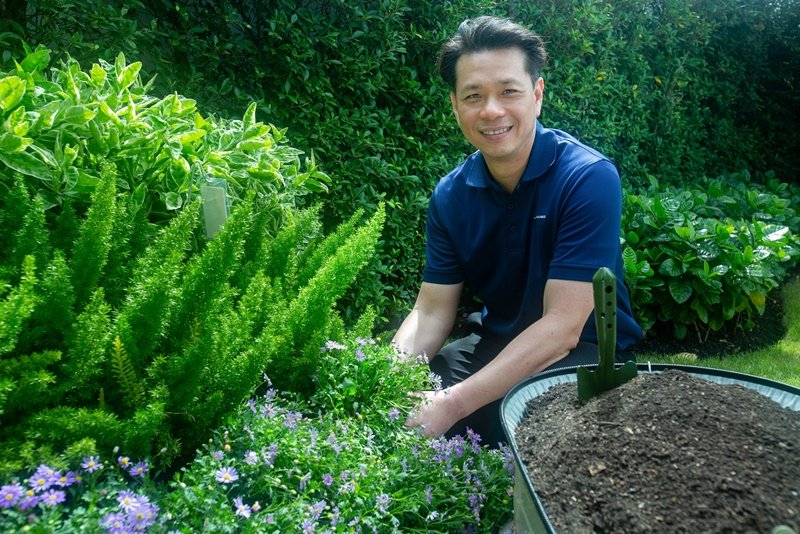
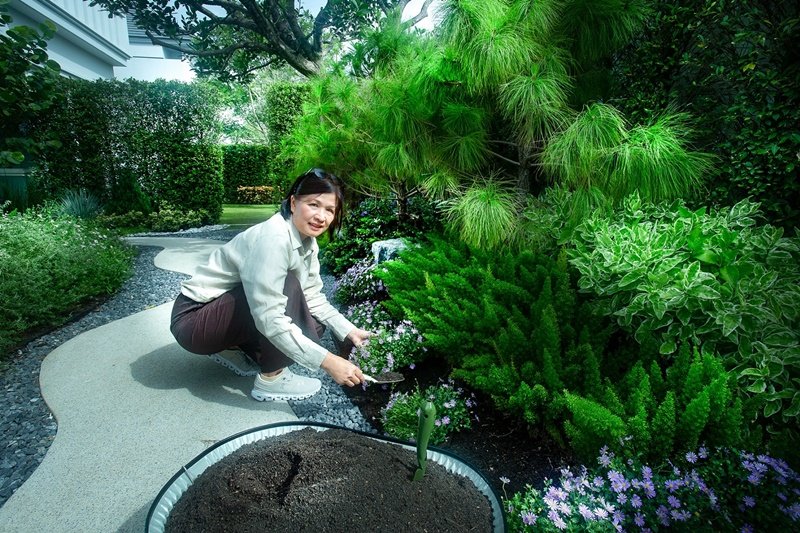
Recently Mr. Poomjai Voravanichakorn, Land and Houses Plc Vice President, Product Development, and Ms. Orasa Rawdbamroe, General Manager, Suanmai Pharadornphap Ltd., Pte., together planted trees with potting (garden) soil derived from the Waste to Well-being Project in a garden of Land and Houses. This year the company initiated a pilot project for leaf waste processing into organic fertilizers for further production of premium potting soil—a cooperative effort between the company and Suanmai Pharadornphap. The project has reduced organic waste for the landfill process by 218 tons (equivalent to 173 tons of carbon dioxide) from January to the end of November this year. To elaborate, once 66 tons of organic leaf fertilizers is derived and proportionally blended with other soil improvement materials, one obtains 55,000 bags of premium potting soil for gardening tasks under the company’s projects while lowering potting soil procurement from others, whose quality may not be homogeneous, or which runs the risk of chemical contamination.
“Our survey of organic waste resulting from our central project tasks in 2024 for 83 projects indicated 4,440 tons of leaf and branch waste which need to be collected and disposed of by landfill, necessitating enormous acreages as well as prohibitive transport and disposal costs. What is worse is the long-term environmental impact. So, in line with the Circular Economy and Sustainable Development Goals (SDGs), Land and Houses has initiated a feasibility study of reusing leaf waste, which tops organic waste amounts under our projects, by turning it into premium potting soil for reuse under our projects instead of buying soil from third parties,” said Mr. Voravanichakorn.
Ms. Rawdbamroe said, “Suanmai Pharadornphap is delighted to participate with Land and Houses under this project. Once we’ve finished collecting and sorting leaf waste, we enter a compost process (for 4-5 months) and then mixture soil preparation, using compost, loamy soil, rice husk charcoal, and chopped coconut. These are blended with soil to obtain potting soil that is superior in quality and odorless, perfect for tree planting.”
During this pilot phase, the company has gathered leaf waste from the common garden areas under 16 projects for the compost process into organic fertilizers, which are blended with other soil improvement materials to yield premium potting soil for eight projects: Nantawan Ratchaphruek – Phran Nok, CHAIYAPRUEK Chaeng Watthana, MANTANA Pinklao – Sai 3, inizio Suksawat – Pracha Uthit, Villaggio Suksawat – Pracha Uthit, MANTANA 100+ Bang Khun Thian – Chai Talay Road, MANTANA 100+ Rama 2 – Bang Khun Thian, and PRUEKLADA Ramindra Expressway – Chatuchot. Gardening outcomes showed that trees had grown and given better yields than if one had used soil procured from markets. Note that the organic fertilizer obtained from the leaf waste compost process had also passed tests at the laboratory of the Academic Soil, Fertilizer, and Environmental Development of Kasetsart University, which have confirmed properties up to the standard range of organic fertilizers defined by the Department of Agriculture.
The Waste to Well-being Project lowers natural resource consumption by producing premium potting soil from leaf waste, lowers soil procurement from third parties, promotes the Circular Economy, and reduces public leaf waste. In addition, it saves expenses for organic waste transport and disposal while promoting suppliers’ capability development together with business opportunities for suppliers for sustainable mutual growth. Based on this success, Land and Houses plans to grow the project in 2026 by applying premium potting soil from the Waste to Well-being Project to its upcoming projects, which include those in provincial areas.