Risk Management and Crisis Management
Policy and Risk Management
Recognizing significant shifts in the business environment that could impact an organization’s ability to strive for sustainable business successes, the Company values risk management as an essential process for managing risks to cope with internal and external uncertainties, enhancing competitiveness and business opportunities to achieve short-term and long-term business goals, as well as boosting confidence among stakeholders.
The Company formulated a risk management policy to guide operations and communicate with all involved parties to promote awareness and compliance. It assigned those in charge of risk management, from the Board of Directors, management to all employees. It also conducts a policy review at least yearly, based on evolving risks affecting the organization. Furthermore, it created a corporate culture of risk management. This implementation ensures a common understanding and awareness of risks, leading to effective development and improvement of the risk management process.
Risk Management Guidelines
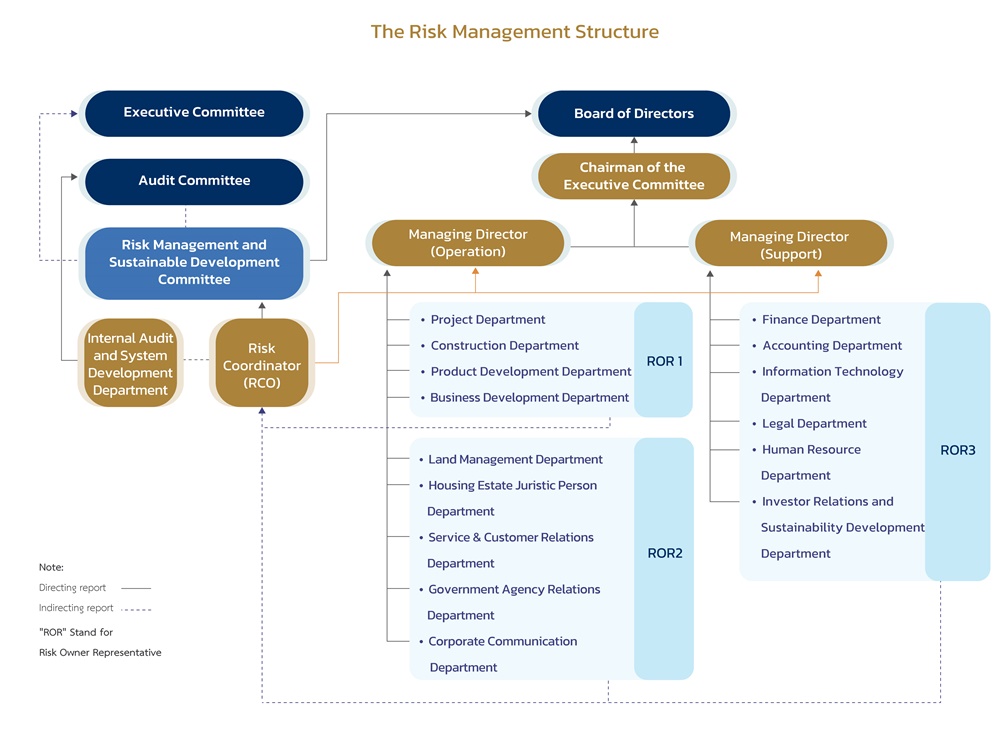
The Company’s risk management framework is guided by internationally recognized standards: the Committee of Sponsoring Organizations of the Treadway Commission, September 2004 (COSO ERM) and the International Organization for Standardization (ISO 31000:2009 Risk Management), including risk determination from economic, social, and environmental perspectives. The process is directly supervised by the Risk Management and Sustainable Development Committee (RMSDC).
Promoting Risk Management Culture
The Company promotes the risk management culture by requiring all parties to serve as risk owners, managing risks from risk identification, analysis, and assessment. It aims to determine mitigation measures, including monitoring and evaluating risks. Then communicating through the department's coordinator reports risk levels and status to top management and the Risk Management and Sustainable Development Committee (RMSDC).
Risk from climate change affecting business operations
Climate change is an urgent and critical global agenda item affecting the environment and socioeconomic adaptation, and the World Economic Forum ranked it as a top global risk. The Company recognizes climate change risk as a crucial issue for it to control the impact and find a way to adapt and grow despite the risk. It has assigned the Risk Management and Social Development Committee to consider, define, review, and improve climate-change strategies, including managing potential risks, before proposing them to the Board. The Committee also oversees and monitors compliance with such strategies.
The Company identified key risks and opportunities related to climate change, such as transition risk and physical risk, and defined the following strategies:
Transition Risk
| No. | Type | Impact Timeframe | Risk and Opportunity | Potential Financial Impact |
|---|---|---|---|---|
| 1 | Policy and law | Medium term and long term (3-20 years) |
|
|
| 2 | Technological change | Medium term (3-10 years) |
|
|
| 3 | Marketing | Long term (more than 10 years) |
|
|
| 4 | Reputation | At any point in time |
|
|
Strategy for Transition Risk Management
- Define policies and goals that cover the efficient use of resources, consumption of alternative energy, and reduction of greenhouse gas emissions to become a low-carbon organization in the future
- Apply the findings of surveys and studies on consumer needs to the design and development of innovative products and services
- Support the development of green innovation and technologies
- Follow up and review performance results of greenhouse gas reduction operations
Physical Risk
| No. | Type | Impact Timeframe | Risk and Opportunity | Potential Financial Impact |
|---|---|---|---|---|
| 1 | Disaster or drastic climate change | Medium term (3-10 years) |
|
|
| 2 | Permanent climate change | Long term (more than 10 years) |
|
|
Strategy for Physical Risk Management
- Create a business continuity management system
- Manage operational safety
Crisis Management
The Company values the significance of responding to critical risks that impact business operations, whether they are elements of nature, such as flash floods and epidemics, or man-made, such as fires, protests, riots, and cyber attacks. Thus, it has introduced the Business Continuity Management System (BCMS) as guidelines for uninterrupted business, for continuous business operation. It also communicates internally with all employees so that they acknowledge and understand the guidelines as follows:
- Determine the key departments or functions responsible as per plan on crisis response, including the Disaster Management Committee.
- Prepare a preventive and response plan : Determine procedures, establish a crisis management command center, and prepare backup work locations.
- Organize drills under the preventive and response plan : Organize an annual drill to ensure that management and employees know their roles and what to do during a given crisis. These drills can also identify shortcomings in established countermeasures so that relevant parties can further improve.
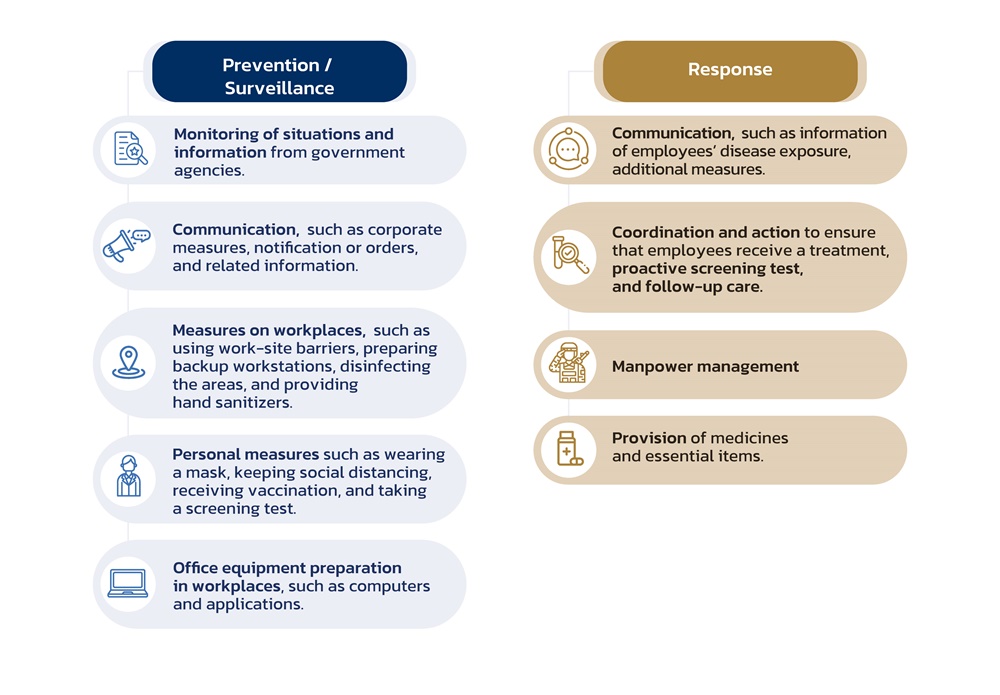
Epidemic prevention and response
To prevent and respond to epidemics, the Company has established a dedicated taskforce to perform the duty under the following guidelines: