
Corporate Governance Structure and the Scope of Authorities and Duties of the Committee
The structure of the Company’s Directors consists of 5 committees, namely the Board of Directors, the Executive Committee, the Audit Committee, the Nomination and Compensation Committee and the Risk Management and Sustainable Development Committee. As of 30 April 2026, the Board of Directors consisted of 9 directors.
| Name | Position |
|---|---|
| 1. Mr. Naporn Sunthornchitcharoen | Chairman of the Board of Directors and Chairman of the Executive Committee |
| 2. Mr. Achawin Asavabhokhin | Director, Member of the Executive Committee, Member of the Risk Management and Sustainable Development Committee |
| 3. Mr. Wit Tantiworawong | Director, Member of the Executive Committee, Member of the Risk Management and Sustainable Development Committee, Member of the Nomination and Compensation Committee |
| 4. Mr. Chokchai Walitwarangkoon | Director, Member of the Executive Committee |
| 5. Mr. Narongrit Chaiyaras | Director, Member of the Risk Management and Sustainable Development Committee |
| 6. Miss Punsopit Worakuttanon | Director and Company Secretary |
| 7. Professor Piphob Veraphong | Director, Independent Director, Member of the Audit Committee, and Chairman of the Nomination and Compensation Committee |
| 8. Mr. Bundit Pitaksit | Director, Independent Director, Member of the Audit Committee, Chairman of the Risk Management and Sustainable Development Committee, Member of the Nomination and Compensation Committee |
| 9. Miss Kluaymai Devahastin | Director, Independent Director, and Chairman of the Audit Committee |
Roles and Duties of the Chairman of the Board
- Take responsibility as leader of the Board to oversee, monitor and supervise the performance of the Board and other sub-committees to achieve the objectives defined in business plans and conform to the corporate governance code.
- Supervise to ensure that all directors have participated in the promotion to create corporate ethics and corporate governance.
- Represent as Chairman of the Board at Board meetings and shareholder’s meetings to handle and manage such meetings in line with the Articles of Association and meeting agenda. Also, allocate proper time for the meetings.
- Promote independent and transparent expression of opinions at the meetings.
- Supervise to ensure efficient communication between directors and shareholders.
- Cast the decisive vote if the votes are tied at Board meetings.
Scope of Duties and Responsibilities of the Board
To enable the Board to perform its duties efficiently, the guidelines for its duties were defined as follows:
- Manage and conduct the business of the Company in line with its objectives and regulations as well as resolutions of the shareholder’s meeting which conform to the laws on integrity and prudence for the utmost benefits of the Company.
- Consider and approve the Company’s key policies, goals, guidelines and business plans, including monitoring and following up implementation under the plans.
- Monitor and supervise the performance and management of the Executive Committee to ensure implement under the assigned policies. The Board is authorized to approve the following matters :
- 3.1 To consider borrowing or loan application from financial institutions.
- 3.2 To consider the annual budget and the Company’s business plans.
- 3.3 To consider interim dividend payments for shareholders if the Company commands enough profit.
- 3.4 To consider significant transactions such as investment, asset acquisition or disposal and other operations required by law.
- 3.5 To consider connected transactions and asset acquisitions or disposals, except when those transactions shall require shareholders’ approval. Such approvals shall be in line with the announcements, requirements and regulations of the Securities and Exchange Commission and the Stock Exchange of Thailand. Except for cases for which the law requires resolutions from the shareholders’ meeting, the Board shall secure approval from the shareholders’ meeting before the operation.
- The Board’s meeting shall be convened at least once every quarter.
- Meetings are scheduled in advance for the entire year. The meeting schedules are provided to the Board at the end of the preceding year, prior the year of meetings.
- The details of the meeting agenda shall be submitted to each director at least 7 days prior to the meeting date so that the directors may have sufficient time to study and consider the details before the meeting.
- In considering each meeting agenda item, the interests of all shareholders and stakeholders must be fairly taken into account.
- The Company has set a policy regarding the quorum at the time when the directors shall vote at the meeting that at least two-thirds of the total directors must attend the meeting.
- Allow free expression of opinions at the meetings.
- Allocate adequate time for each agenda item to allow for debate and careful expression of opinions.
- Supervise to ensure that the Company’s management accompanies a good governance policy to prevent conflicts of interest.
Remuneration of the Directors and Executives
(1) Monetary Remuneration
| Remuneration | Number of Directors and Executives | The Board of Directors' and Executives' Remuneration in 2025 (Baht) |
|---|---|---|
| The Directors and Executives’ Annual Remuneration and Bonus | 9 | 12,580,000 |
| The Executives’ Salary and Bonus | 7 | 97,570,000 |
| Iendent Directors’ Meeting Allowance | 3 | 1,260,000 |
Remarks:
- Bonus, for the performance of 2024, was paid in March 2025.
- The executives of the company as defined by the Securities and Exchange Commission
(2) Non-Monetary Remuneration
- The Company’s directors received other benefits including the directors and executives liability insurance and company reimbursement insurance (D&O), and the expenses for attending seminars and training courses of Thai Institute of Directors Association and related institutions.
- The executives received other benefits similar to employees in several forms such as contribution to the provident fund, medical care, health insurance, an annual physical checkup plan categorized by age, life insurance, allowances for wedding, allowances for the funerals of employee’s family, uniforms, annual trips and parties, including privileges for employees to purchase products at a discount subject to Company’s terms and conditions.
Clawback Provision
According to Section 85 of the Public Limited Company Act B.E. 2535, and Sections 89/7, 89/18, 89/19, and 281/2 of the Securities and Exchange Act B.E. 2535 (As amended in B.E. 2551), the directors and executives of the Company shall perform their duties with integrity.
In the event that the directors or executives of the Company fail to perform their duties with integrity, resulting in any damage to the company, the company will be eligible to claim compensation from such directors or executives, or initiate legal proceedings to recover the benefits they gained through such conduct (Clawback).
| Name | Position |
|---|---|
| 1. Mr. Naporn Sunthornchitcharoen | Chairman of the Executive Committee |
| 2. Mr. Wit Tantiworawong | Member of the Executive Committee |
| 3. Mr. Chokchai Walitwarangkoon | Member of the Executive Committee |
| 4. Mr. Achawin Asavabhokhin | Member of the Executive Committee |
Scope of Duties of the Executive Committee
The Executive Committee, including the managing directors, has the power and duty to manage matters related to the normal business operations of the Company. The approval of transactions featuring conflicts of interest in any manner with the Company or its subsidiaries must be presented every time to the Audit Committee and the Board meeting to consider and approve.
| Name | Position |
|---|---|
| 1. Miss Kluaymai Devahastin | Independent Director, Chairman of the Audit Committee |
| 2. Professor Piphob Veraphong | Independent Director, Member of the Audit Committee |
| 3. Mr. Bundit Pitaksit | Independent Director, Member of the Audit Committee |
Scope of Authorities and Duties of the Audit Committee
The Audit Committee has the following scopes, duties and responsibilities:
- Review the Company’s financial reports to ensure accuracy and adequate disclosure.
- Review the Company’s internal control and internal audit systems to ensure suitability and effectiveness.
- Review the operations of the Company to ensure its compliance with laws and regulations regarding the securities and the stock exchange or other regulations related to the Company’s business.
- Approve the appointment, transfer, and termination of the head of Internal Audit.
- Screen, nominate, reinstate, and terminate the employment of external auditors, including consideration of the appropriateness of the audit fee.
- Examine and review proper and adequate disclosure of the Company’s information on connected transactions or transactions which may lead to potential conflicts of interests to ensure its comprehensiveness and accuracy as required by related regulations.
- Consider and review operational reports of Internal Audit and approve its annual internal audit plan.
- Supervise the auditors and Internal Audit for freedom in performing their duties.
- Organize meetings with auditors in the absence of management at least once a year.
- Determine key risks of the Company and propose or provide preventive mitigation measures to the Board.
- Prepare reports on the activities of the Audit Committee to be included in the Company’s annual report, signed by the Chairman of the Audit Committee.
- Perform other tasks as assigned by the Board, with the approval of the Audit Committee.
| Name | Position |
|---|---|
| 1. Professor Piphob Veraphong | Independent Director, Chairman of the Nomination and Compensation Committee |
| 2. Mr. Bundit Pitaksit | Independent Director, Member of the Nomination and Compensation Committee |
| 3. Mr. Wit Tantiworawong | Member of the Nomination and Compensation Committee |
Scope of Authorities and Duties of the Nomination and Compensation Committee
- Establish a policy on the selection and nomination of directors, sub-committees and senior executives as well as proposing appropriate compensation to the Board for approval.
- Recruit persons with appropriate qualifications that can benefit the business to replace directors who retire by rotation or fill vacant positions and propose these to the Board for approval, including seeking approvals from shareholders.
- Determine necessary and appropriate remuneration, both cash and non-cash, for directors and senior executives, based on their duties, responsibilities, and performance.
- Report the minutes of meetings which are significant and beneficial to the Company to the Board.
- Provide explanation or answers to questions in case of suspicion regarding the Company’s policy on the nomination and compensation of the Company’s directors, sub-committees, and senior executives at the shareholders’ meeting.
- Perform other Board-assigned tasks related to significant nomination and compensation.
| Name | Position |
|---|---|
| 1. Mr. Bundit Pitaksit | Independent Director, Chairman of the Risk Management and Sustainable Development Committee |
| 2. Mr. Wit Tantiworawong | Member of the Risk Management and Sustainable Development Committee |
| 3. Mr. Achawin Asavabhokhin | Member of the Risk Management and Sustainable Development Committee |
| 4. Mr. Narongrit Chaiyaras | Member of the Risk Management and Sustainable Development Committee |
Scope of Authorities and Duties of the Risk Management and Sustainable Development Committee
- To define and review policies, objectives, guidelines, and frameworks for enterprise risk management to cover key risks, including Strategic Risk, Financial Risk, Compliance Risk, Operational Risk, Corruption Risk, and sustainability risks related to Environmental, Social, and Governance (ESG), economic risks affecting business sustainability and emerging risks. The policies and objectives shall be proposed to the Board of Directors for approval.
- To oversee, advise, monitor, and review risk management mitigation plans in conjunction with Key Risk Indicators (KRIs), as well as regularly evaluate and improve risk management processes to ensure that they are adequate, appropriate, and effective. This includes ensuring that risks are managed within the acceptable risk level (Risk Appetite), in accordance with international standards, aligned with the Company’s strategy, business plans, and evolving business environment, and fostering a risk-aware culture throughout the organization.
- To consider, define, review, and improve strategies, objectives, and action plans for sustainable development across ESG dimensions, ensuring alignment with the Company’s business operations and international best practices. The Committee shall promote practical implementation and support engagement in sustainable development projects with internal and external parties to create sustainable value for all stakeholders. The strategies and objectives shall be proposed to the Board of Directors for approval.
- To consider, define, review, and improve strategies, objectives, and action plans related to Climate Change, including the management of climate-related risks and opportunities aligned with international standards and practices. The Committee shall oversee and monitor performance and disclosure to ensure transparency and effectiveness. The strategies and objectives shall be proposed to the Board of Directors for approval.
- To report on risk management and sustainable development performance, including significant issues beneficial to the Company’s business operations, to the Board of Directors.
- To conduct a self-assessment of the Committee’s performance at least once a year.
- To perform any other duties as assigned by the Board of Directors.
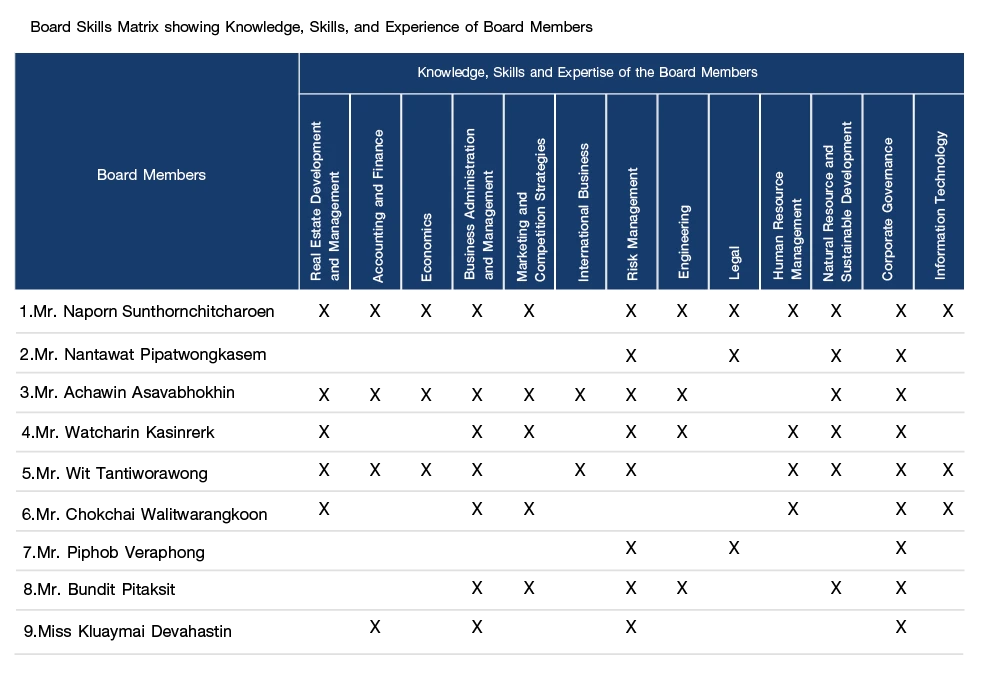
As of 31 December 2025, the resulting board diversity is illustrated by the Board Skills Matrix shown below:
To ensure optimal work efficiency and dedication to duties assigned to members of the board committees, all directors including the Chairman of the Executive Committee, executive directors, non-executive directors, and independent directors shall not hold directorship in more than 5 listed companies.