Sustainable Supply Chain Management
Significance and Management Approaches
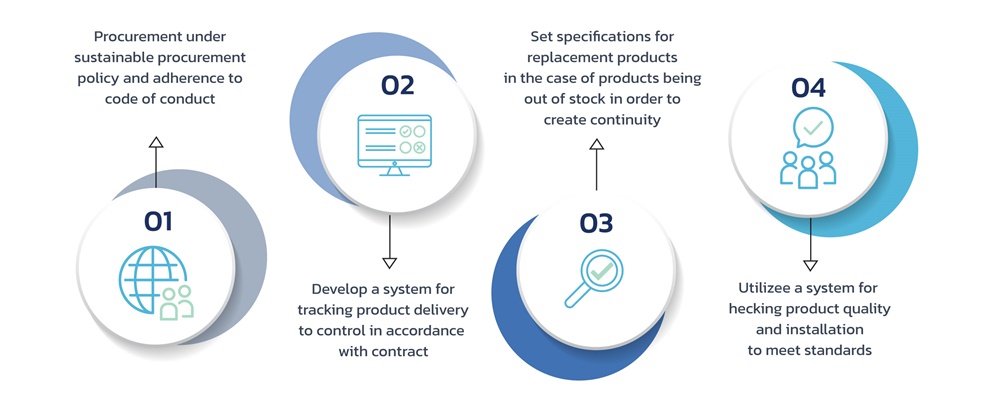
The Company commands supply chain management to help reduce risks from the actions of suppliers. This may impact business operations and increase efficiency in delivering good products and services of suppliers. It demonstrates the transparency and fairness of the procurement process in parallel with the encouragement for suppliers to follow the Company's code of conduct for suppliers in order to achieve common sustainable growth.
Payment Policy to Suppliers
The Company can pay suppliers fairly within the period specified according to the payment policy to suppliers, that is, within 30 days for general suppliers and 15 days for contractors for construction projects. In 2023, the Company made payment to general partners within an average of 30 days and to contractors in construction projects within an average of 15 days.
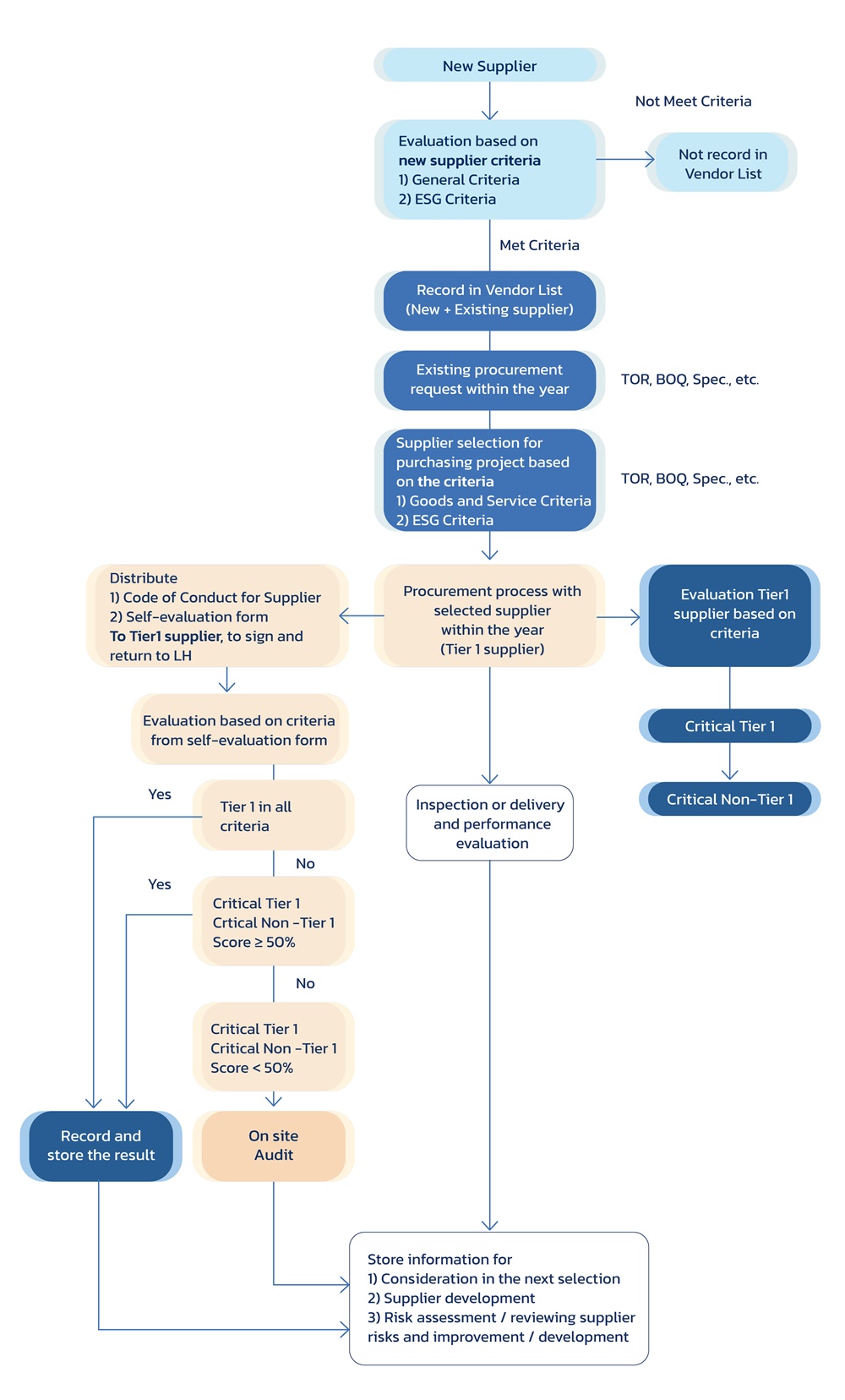
Selection of New Suppliers in the Procurement Process
To ensure that new and efficient suppliers are selected, the Company establishes the criteria for selecting suppliers to cover all three aspects of sustainable development, namely the environmental, social, and corporate governance and economic (ESG) aspects, so that all parties involved are informed and act in a uniform direction.
- General qualification criteria for new suppliers
- Able to verify the identity of customers.
- There is important evidence showing that the supplier has correctly registered for VAT as required by law.
- In possession of documents showing business ownership and having passed the examination of related-party transactions to prevent conflicts of interest and business decisions.
- Set clear payment channels.
- Possess appropriate qualifications or experience in carrying out the work under procurement.
- Possess production quality and delivery standards as well as responsibility for the quality of products and services.
- Criteria for ESG:
- Environmental aspect
- Environmental policy
- Environmental management
- Monitoring environmental impact
- Social aspect
- Safety and occupational health
- Human resource development
- Labor management and human rights
- Governance and economic aspect
- Compliance with laws and regulations
- Responsible procurement
- Business ethics/code of conduct.
Selection of Suppliers in the Procurement Process
The Company establishes criteria for selecting suppliers in the procurement process by considering and evaluating suppliers in two aspects: general evaluation and evaluation of ESG.
- General criteria for selecting and evaluating suppliers in the procurement process
- Be a manufacturer, entrepreneur, seller, distributor, service provider, or contractor whose establishments can be verified.
- Command personnel, machinery, equipment, products, financial status, and reliable business history.
- Accept and follow the Company's Supplier Code of Conduct.
- Be a supplier with a satisfactory performance record. The Company will evaluate the work based on the quality of products and services.
- Be a supplier with no conflict of interest with the Company's business.
- Be a supplier with no history of trade ban due to dishonest operation.
- Criteria for ESG
- Environmental aspect
- Environmental policy
- Environmental management
- Monitoring of environmental impact
- Social aspect
- Safety and occupational health
- Human resource development
- Labor management and human rights
- Governance and economic aspect
- Compliance with laws and regulations
- Responsible procurement
- Business ethics/code of conduct.
Determination of Critical Tier 1 Suppliers and Critical Non-Tier 1 Suppliers
The Company considers Critical Tier 1 Suppliers and Critical Non-Tier 1 Suppliers by using the criteria for the consideration in three aspects.
| Criteria | Indicator |
|---|---|
| Importance of products and services | Products and services are important to the Company's business operations. |
| Level of dependence of supplier | Irreplaceable supplier or one of small number of suppliers |
| Procurement value | Supplier with the highest procurement volume of 60% of the total procurement volume. |
Environmental, Social, and Governance (ESG) Risk Assessment
The Company requires the assessment of ESG Risk of all Tier 1 Suppliers once a year. Critical Tier 1 Suppliers who have been assessed to have high risk (with scores lower than 50%) must also be assessed at their establishment.
| Types of suppliers | Document review and online assessment (1 time/year) |
Assessment |
|---|---|---|
| Tier 1 Suppliers | ✓ | |
| Critical Tier 1 Suppliers | ✓ | |
| Critical Tier 1 Suppliers who have been assessed to have high sustainability risk (score below 50%) | ✓ | ✓ |
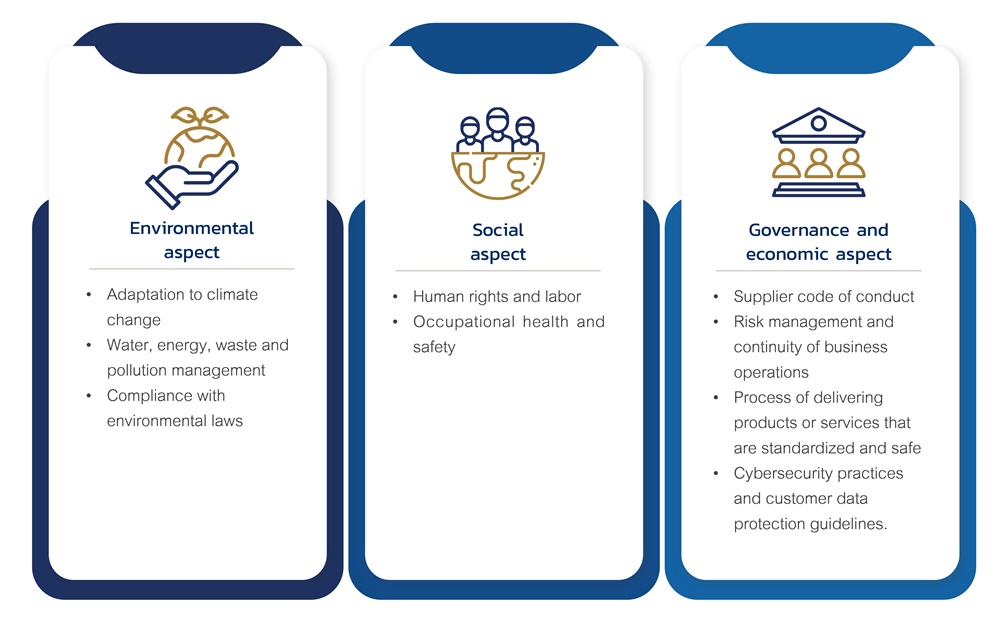
The Company assesses ESG Risk on all key suppliers, covering old and new suppliers, by collaborating with relevant departments and parties in developing risk assessment criteria and self-assessment forms for suppliers. They cover major risk issues as follows:
Supply Chain Management