
Water and Wastewater Management
Significance and Management Approaches
The Company realizes that water is an essential part of business operations, whether as part of activities in construction projects or for consumption in offices. Therefore, it has devised methods of water management to ensure efficient consumption of water as well as wastewater management from construction projects to ensure that it does not cause pollution to surrounding communities:
Water and effluent management at Head Office
- Use water-saving faucets to reduce water consumption
- Campaign and raise awareness of employees for economical use of water
- Wastewater from Head Office will go into the central wastewater treatment system of the building that the Company rents. The building will then treat the wastewater and test the quality of the effluent to meet legal requirements before releasing it into public pipes.
Water and Wastewater Management in Projects
- Design and use prefabricated materials from factories to assemble at construction sites. This reduces the amount of water that would otherwise be consumed if it used conventional construction methods.
- Use water-saving sanitary ware such as faucets or showerheads which also ease customers’ household expenses.
- Design an effluent/wastewater treatment system that meets the standards required by law
- Conduct quality wastewater treatment required by the standard, monitor the quantity and quality, and report the performance of wastewater treatment system as stipulated by law
- Reuse treated wastewater
- Develop knowledge and ability of personnel responsible for wastewater treatment systems.
As for the wastewater treatment of a given project, wastewater will flow through the grease trap and the septic tank into the project’s central manhole. It is then pumped into an aeration lagoon to improve the water quality to meet the standard. Some treated wastewater will be reused in the project’s common areas such as watering of trees. The rest will be released into drains or public canals.
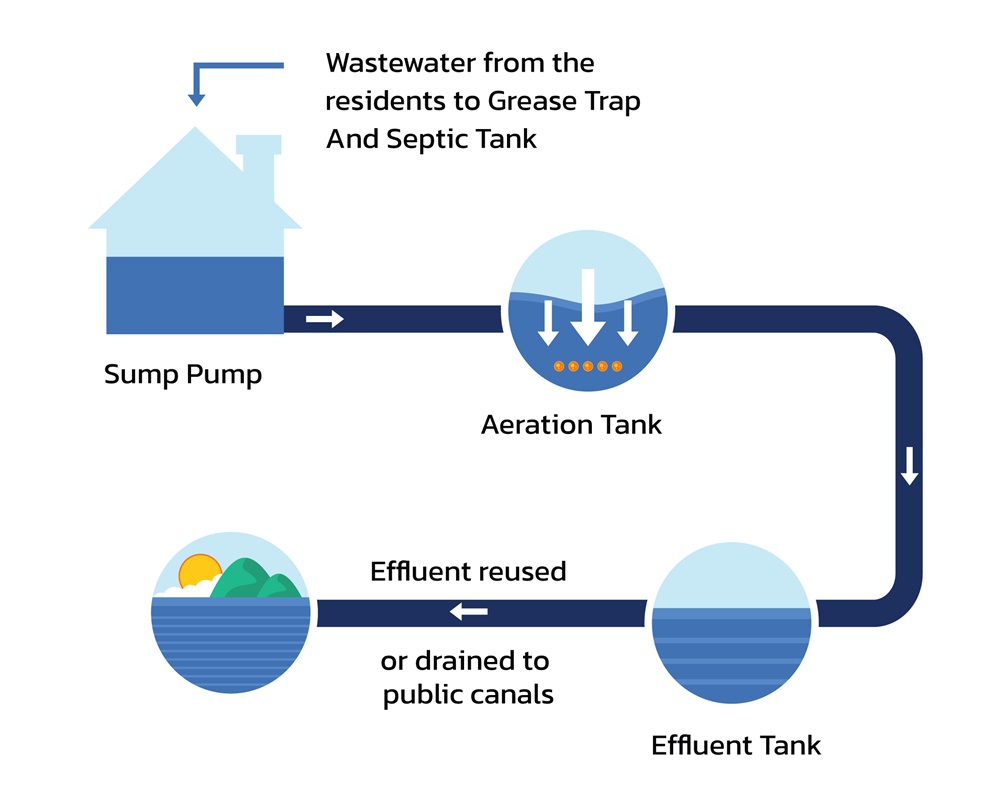
When a given project’s construction is completed, the Company’s service department will take care of the wastewater treatment system. Environmental engineers will be responsible for the control of wastewater treatment system as required by law. To ensure that every step of its water treatment testing process complies with the law, the Company has outsourced and made an annual contract with a third party, a certified environmental specialist, to test and analyze water quality. In a quarterly inspection, the engineering team checks the overall condition of the wastewater treatment system within the specified period so that the water treatment system can work at full capacity. The team takes water samples from the treatment system for analysis of the chemical values in an ISO/IEC 17025-accredited laboratory to measure the parameters of the wastewater1 and compares it with government standards. However, if the quality of water fails to pass the criteria, the responsible team will continue investigating and finding solutions to the issue.
The Company determines that the operation and maintenance of wastewater treatment system in all projects will be the Company’s responsibility until the project is handed over. It will also train residential juristic persons to take over the tasks.
Remarks: 1 Potential of Hydrogen (pH), Biochemical Oxygen Demand (BOD), Suspended Solids (SS), Total Dissolved Solids (TDS), Settleable Solids (SS), Oil & Grease (O&G), Total Kjeldahl Nitrogen (TKN), Sulfide (S2-)
Water and Wastewater Management Goals
| Short-Term Goal (2025) | Long-Term Goal (2027) |
|---|---|
| 5% reduction in water consumption of total water consumption (base year: 2022) | 10% reduction in water consumption of total water consumption (base year: 2022) |